
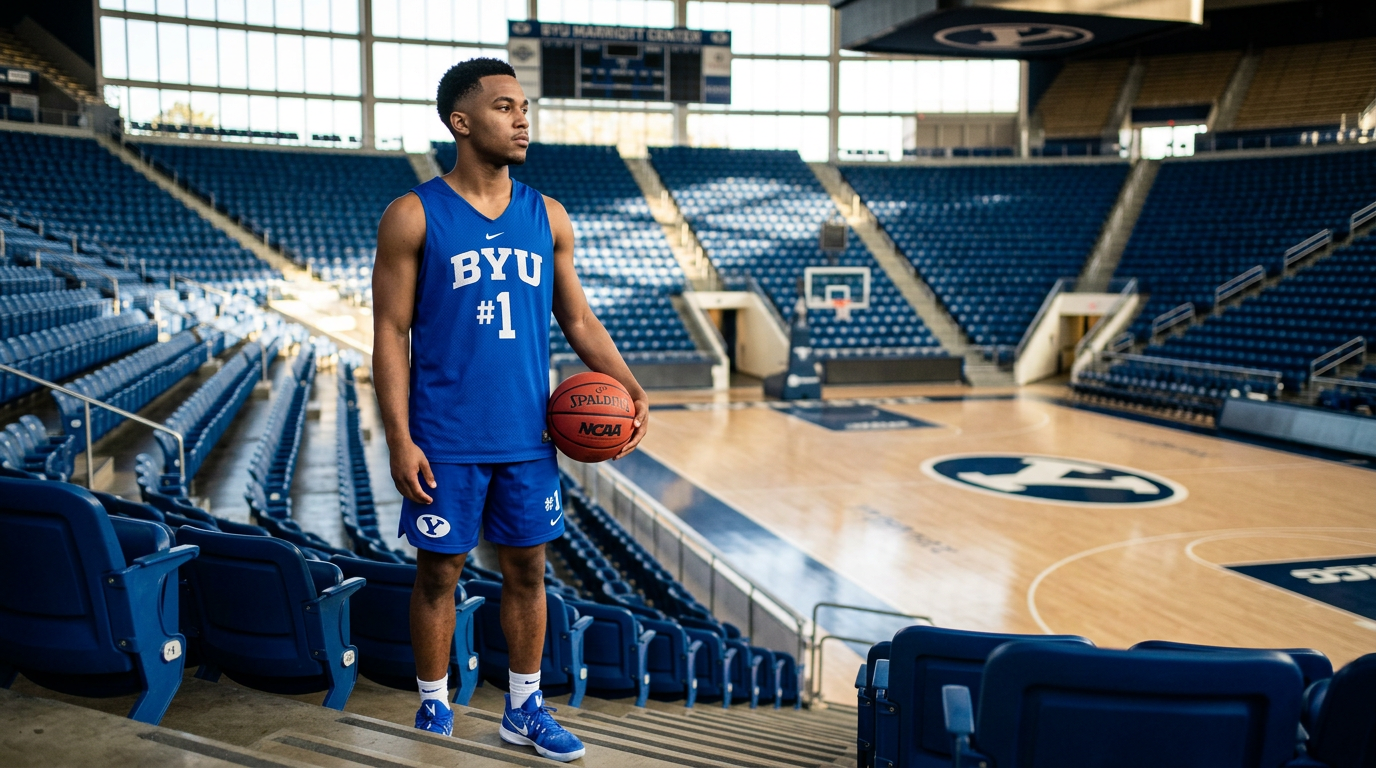
The portal's best point guard went to Lexington on Tuesday. He came home to Provo on Wednesday. BYU didn't raise his $3.5 million from last year. Kentucky offered more and still lost.
That's the short version of the Rob Wright saga, which lasted exactly one week and rewrote what we thought we knew about Kentucky's war chest.
Wright entered the portal on April 8. He was the top-rated point guard available by every service that ranks these things — 18.1 points, 4.6 assists, 41% from three on 34.9 minutes a night. A 6-1, 183-pound sophomore out of Wilmington, Delaware by way of Neumann-Goretti and Montverde. He dropped 39 on Colorado and 30 on Baylor and hit the game-winner at Clemson in December. Third-team All-Big 12 as a sophomore. Nineteen points in the NCAA Tournament upset of Mississippi State. The kind of guard who gets paid.
The expectation, inside the industry, was that he'd price himself out of Provo. Reporting had him making $3.5 million in BYU's collective last season. He entered the portal looking for a raise. BYU said no.
That part was surprising.
A market nobody expected
BYU has out-earned just about everyone in college basketball under Kevin Young. They signed AJ Dybantsa — the probable No. 1 pick — to what was believed to be the biggest NIL deal in the sport's history. They kept Richie Saunders long enough to win All-Big 12. But Wright's raise request came at the wrong time. Dybantsa is gone. Saunders is gone. BYU is rebuilding a core and trying to stretch dollars across eight roster spots. Paying a premium on a guy who's already on your team, in a window where the board is thin at every other position, didn't work out on the spreadsheet.
So Wright went to visit Kentucky.
The visit was two days long. Monday and Tuesday. Insiders said the Wildcats were the final competition — Louisville had already pivoted to Jackson Shelstad, St. John's had moved to Quinn Ellis. On Wednesday morning, Wright was back to BYU.
What happened? Jeff Goodman said it cleanly. Kentucky "doesn't have the money they had last year." They spent $22 million last offseason. The roster finished 20-13 and missed the tournament. The collective is stretched. Mark Pope's program hadn't even hired a general manager before the portal opened — a structural problem, not just a cash problem.
Kentucky pivoted to Zoom Diallo, the Washington sophomore. Fifteen points, four and a half assists. Solid player. Not Wright.
Lexington's new reality
This is the weird part of the 2026 portal. We keep assuming Kentucky is still the market. They're not. At least not the way they were. A $22 million class that missed the tournament leaves a collective without leverage. One year later, the program is outbid by a school in Utah with no football brand behind it and no incoming SEC money.
Nobody saw that coming two years ago. Everybody sees it now.
This is the second big name Pope has lost this spring. They didn't get Koa Peat in the high school cycle. They didn't get Wright in the portal. They got Diallo, who's a fine player but nobody's idea of a franchise point guard. The window closes April 21. There's not much left on the board at guard.
What BYU has now
Wright is the lone returning starter. Dybantsa gone, Saunders gone, and the roster in some state of flux. But that one starter is the best point guard in the Big 12 not named Braden Smith. His 4.6 assists per game were top-20 in the league. His 41% from three on his usage was top-ten for any guard who saw 30-plus minutes a night. Losing him would have meant starting a freshman at the point next season and running a different offense entirely. That wasn't a realistic path for a program with Final Four ambitions.
Young deserves some credit for the back end of this. Public reporting said BYU wouldn't pay the raise. That's true. But holding a player who already visited the other side and came home — that takes a piece of relationship, not just math. Young had coached Wright for a full season. He knew what to say. He also knew what BYU could offer that Kentucky couldn't: a defined role, a real shot at a top-four NCAA Tournament seed, and a supporting cast with incoming four-stars and Collin Chandler returning from his mission.
The other layer here is what this says about the portal market in 2026. Two years ago, a player of Wright's caliber would have had programs waiting on his decision. Now they pivot. Louisville cleared the market. St. John's cleared the market. Kentucky pivoted inside 48 hours. When Wright got home from Lexington, the remaining real suitor was BYU — the same BYU that wouldn't give him the raise. He took the original deal and ended the saga.
The over-under just moved
BYU's win total for 2026-27 was floated at 22.5 before Wright decided. That number moves now. It moves a lot.
Kentucky plays at Rupp with a point guard who averaged 15 at Washington. BYU plays at the Marriott Center with one who averaged 18 in the Big 12, hit 41% from three, and just turned down more money to stay.
The market got what it paid for.