
$34 Million, Then Nothing
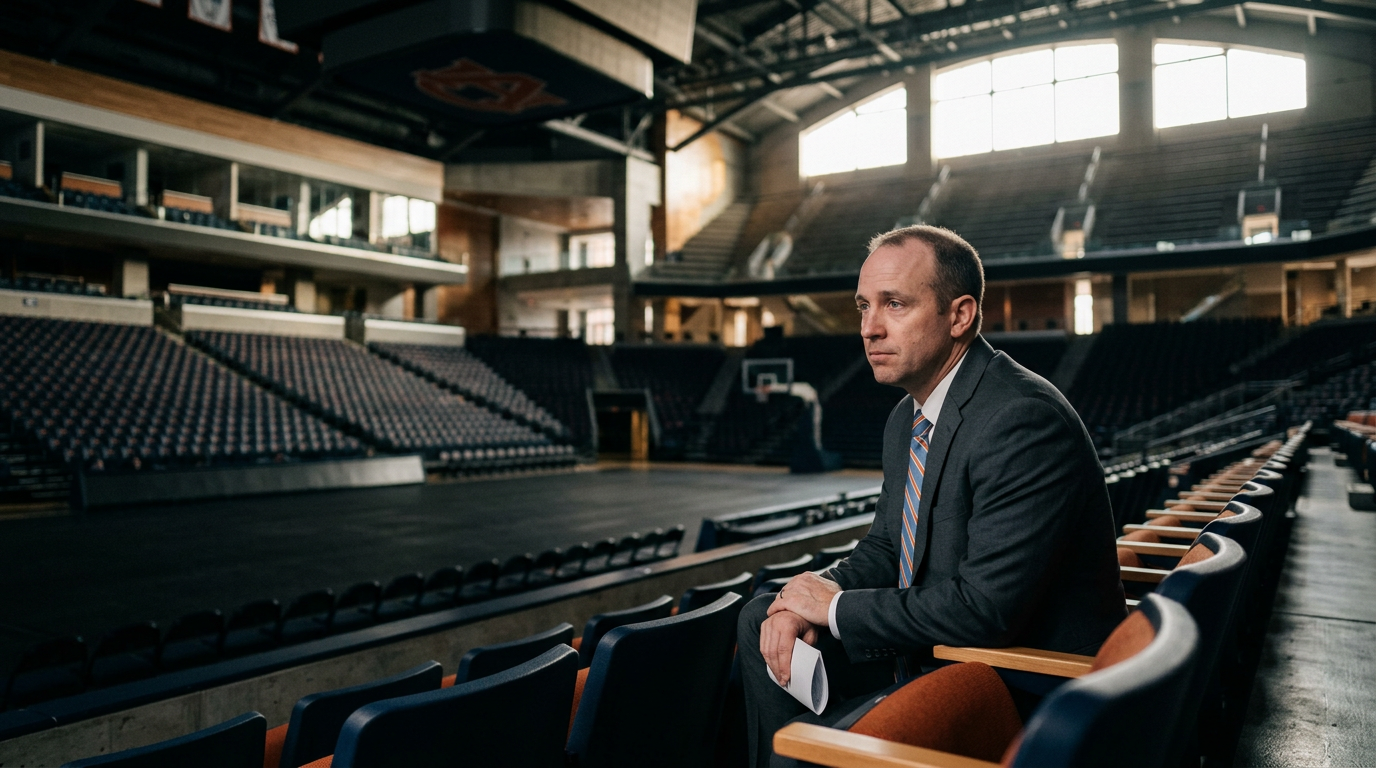
Campbell University opened a $34 million basketball arena in 2008. Three thousand seats, all chairbacks. A hundred thousand square feet in Buies Creek, North Carolina, population not much more than the arena holds. It was a statement from a private Christian school with 2,700 undergrads: we're serious about Division I basketball.
Eighteen years later, the school can't fund the team that plays in it.
John Andrzejek resigned as head coach on April 1 after one season. He went to Louisville as Pat Kelsey's associate head coach. His resignation letter — posted on social media — was the most honest thing anyone in college basketball wrote this year.
"Over the last six months, it has become clear that Campbell has made the decision to shift their commitment from basketball," Andrzejek wrote. "Simply put — the institution now has different priorities."
$34M Arena, $0 Commitment
One Year
Andrzejek was 32 when Campbell hired him. That was less than 48 hours after he helped Florida win the 2025 national championship as the Gators' defensive coordinator. ESPN had him on their "40 Under 40" list at 27. He tracks 42 different performance metrics. He's exactly the kind of young coach mid-majors are supposed to bet on.
His team went 16-18, 8-10 in the CAA. Ninth place. DJ Smith made First Team All-CAA at 19 points a game. They beat UNC Wilmington in the conference tournament before losing to Monmouth. Not a bad first year.
It was also apparently the last one Campbell is willing to fund.
The Math
Campbell's basketball budget is $2.2 million a year. That ranks 260th in Division I — down from 198th a decade ago. In 2014, the gap between the 30 largest and 30 smallest D-I basketball budgets was 13.5x. By 2024, it was 16.6x. It's wider now.
Total college basketball NIL spending hit $932.5 million in 2025-26. Power conference rosters cost $7 to $10 million. The top programs spend $15 to $25 million. Campbell's entire basketball budget is less than what some individual players earn.
Revenue sharing launched in July 2025 with a $20.5 million annual cap per school. That cap climbs to $33 million by 2035. The gap isn't closing. It's accelerating.
In July 2025, Campbell put out a statement: "The House settlement is one of the biggest changes ever to college athletics. Through this process, Campbell has planned and prepared, and as a result, our department is stable and poised for growth."
Nine months later, their coach resigned because the school wouldn't fund the program. "Stable and poised for growth" aged about as well as milk.
Simply put — the institution now has different priorities, and they are not compatible with putting the kind of team on the floor that you deserve
The Gap
The Pattern
Campbell didn't start with basketball. In October 2024, the school cut wrestling scholarships from 9 to 3. Swimming and track got restructured. Multiple coaches in affected sports left. A new president, Dr. William Downs, took over July 1, 2025, with priorities that apparently didn't include competing in the CAA.
Andrzejek tried to make it work. He spent months with AD Hannah Bazemore exploring options. His letter was specific about that: "Despite months of intense work and collaboration with AD Hannah Bazemore and our terrific athletics administration, and several creative options that were proposed and thoroughly explored, there are no pathways that the institution will support to fund the program appropriately moving forward."
He thanked the outgoing president and Bazemore by name. He called the decision-maker "the institution." The distinction was deliberate.
Not Just Campbell
Same week Andrzejek left, Akron's John Groce bailed for Charleston. Groce had won four MAC tournament titles in five years. He went 29-6 his last season. He left because Charleston would share more revenue with players. Akron wouldn't.
St. Bonaventure hired a D-II coach at half the salary of the predecessor. The savings went to player revenue sharing. When your coaching hire is dictated by how much you can redirect to NIL, the economics have changed.
Geno Auriemma called it: "The portal and the revenue share, I think that was the death of the mid-majors." Power conference coaches now recruit from mid-major rosters instead of high schools. You develop a player for two years. He gets good. A Big 12 school offers him real money. He leaves. You start over.
Eighteen percent of Division I schools opted out of revenue sharing entirely. They looked at the math and decided they couldn't compete. Campbell didn't opt out. They just stopped pretending.
The Associate Head Coach
Andrzejek is 33. He helped Florida win a national championship. He ran a mid-major for a year. Now he's an assistant at Louisville.
At Louisville he'll coach in the ACC with real resources. Kelsey called him "an animal." Todd Golden credited Andrzejek for Florida's defensive transformation — from 327th in scoring defense to 6th in adjusted efficiency in one year. The man can coach.
He'll be fine. Campbell's next hire inherits a $2.2 million budget, a beautiful arena, and an institution with "different priorities."
Different Priorities
Here's the thing about that resignation letter. Andrzejek didn't trash the school. He wrote it like someone who understood the math and respected the people who tried to solve it with him.
"As difficult as this is, I respect the decision and I understand it as one that the University feels it must make in what are unprecedented times in higher education."
That sentence should scare every mid-major AD in the country. He's not saying Campbell is wrong. He's saying the economics of college basketball in 2026 make it rational for a school to build a $34 million arena and then stop funding the team inside it.
Campbell has one NCAA Tournament appearance in its history. A 16-seed loss to Duke in 1992. The arena is still there. The commitment isn't.