He Was Already There
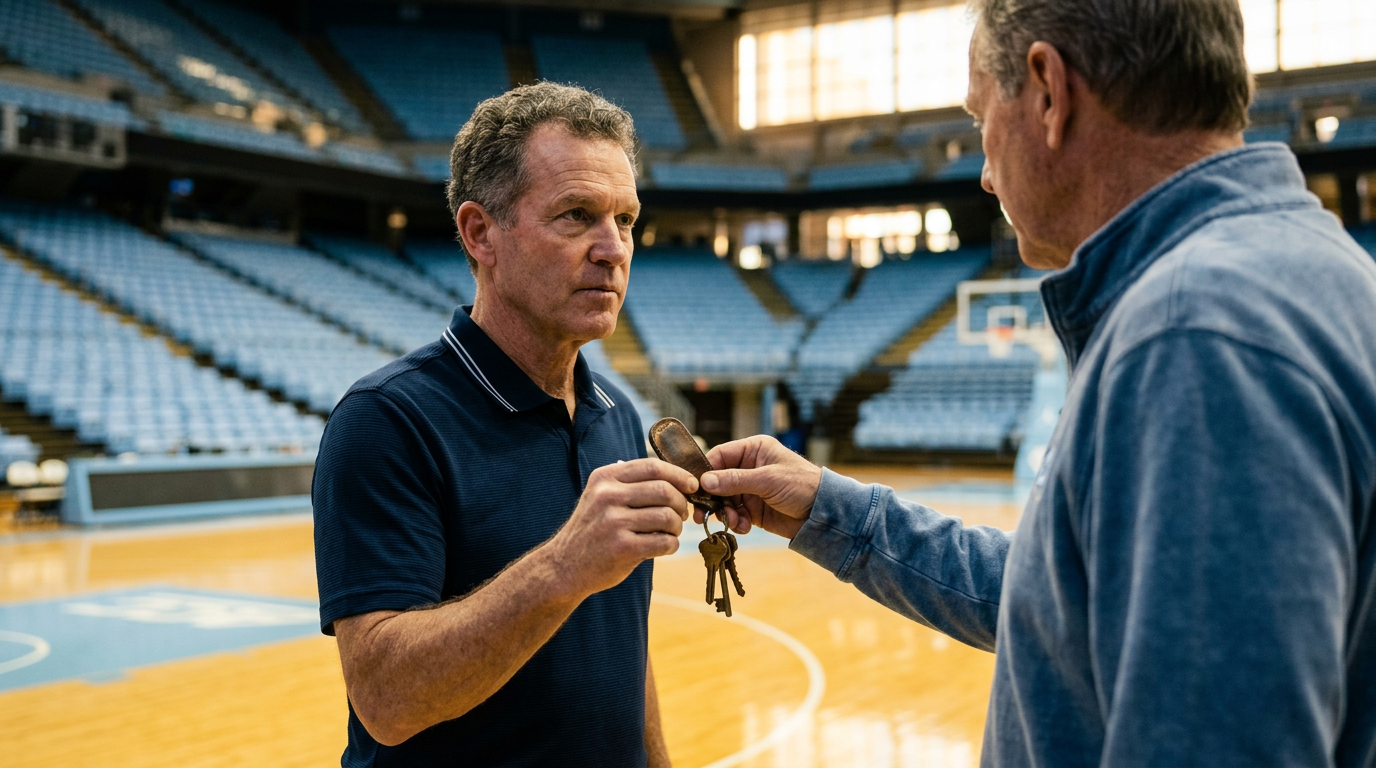
Six months ago, Michael Malone stood on the floor of the Dean Smith Center and watched Hubert Davis run practice. He wasn't scouting. He wasn't interviewing. His daughter Bridget plays volleyball for North Carolina, and Davis had extended a standing invitation — come watch, stand on the floor, talk to the players if you want. Five or six times last fall, Malone took him up on it.
In October, he went on the "Carolina Insider" podcast and said something that reads very differently now: "The amount of love and passion he's pouring into his players every practice has been incredible to watch." He also told the hosts he was still a coach at heart. "I'm a coach, I'm a teacher," he said. He'd love the right opportunity.
On Sunday, North Carolina announced it intends to hire Malone as the 20th head basketball coach. He replaces the man who invited him to practice. He has never been a college head coach — not at any level, not for a single game.
The Outsider Who Was Already Inside
Everyone Said No
The chain of rejections that led UNC to Malone could fill its own article. We've been tracking this search since March 25, when chancellor Lee Roberts and outgoing AD Bubba Cunningham fired Davis after a 19-point first-round collapse against VCU — the largest first-round blown lead in tournament history.
Brad Stevens said no in 12 hours. Tommy Lloyd used UNC's interest to extract a $7.5 million-per-year extension from Arizona, then told reporters his "Michael Jordan is Steve Kerr" — confirming the rumored Jordan phone call never happened. Dusty May told Michigan he wasn't leaving. Nate Oats invoked his daughters. T.J. Otzelberger deflected at a press conference. Scott Drew stayed at Baylor. Ben McCollum turned down a Sunday interview request. Mark Byington didn't engage.
Billy Donovan was the last domino. The betting favorite for weeks, he never formally removed himself — he just went quiet. His NBA season doesn't end until April 12, and UNC couldn't wait. The transfer portal opened Monday morning. Every day without a coach was a day the roster bled.
HoopsHQ described the search as "mired in dysfunction." They weren't wrong. Chancellor Roberts — a Duke graduate — had proposed moving the historic Smith Center off campus, sparking a revolt from Roy Williams and the broader Carolina basketball family. The Bill Belichick football hire still hung over the athletic department. Larry Brown told reporters, "I don't speak for all Carolina guys, but the ones I speak to, they don't want to see it end."
Into this mess walked a 54-year-old NBA lifer whose strongest connection to the university is a sophomore volleyball player who wears number 10.
A Coach's Son
Michael Malone grew up in NBA arenas. His father, Brendan, was a lifer — a high school coach from Astoria, Queens, who played one game at Iona College and spent the next four decades climbing to the top of professional basketball. He became famous for one specific skill: defending Michael Jordan.
As an assistant with the Detroit Pistons during the Bad Boy era, Brendan Malone was considered the league's leading authority on slowing down the greatest player alive. The "Jordan Rules" were a team effort. The game plans were Brendan's. He went on to become the first head coach in Toronto Raptors history, hired by Isiah Thomas in 1995. He coached in New York, Cleveland, Detroit, Indiana — everywhere the game took him. Michael and Brendan became the second father-son duo to each serve as NBA head coaches, after Bill and Eric Musselman.
Michael played at Loyola Maryland from 1989 to 1993, transferring to Seton Hall Prep in high school when his father joined the Knicks staff. He was coaching by 21 — the Friends School of Baltimore in 1993, then Oakland University, then Providence as an assistant under Pete Gillen from 1995 to 1998. Manhattan from 1999 to 2001 was his last college stop. The NBA assistant circuit was his next education — the Knicks, Cavaliers, Hornets, Warriors. Sacramento gave him his first head coaching job in 2013. He was 41, young for an NBA coach, and the Kings were a disaster. He went 39-67 before getting fired 28 games into year two. Three months later, Denver hired him. Everything before that was preamble.
Brendan spoke fondly of Dean Smith in interviews over the years. Michael grew up hearing about the Carolina program from someone who'd been in NBA coaching circles with Smith's disciples for decades. The connection to Chapel Hill runs deeper than a volleyball roster.
The amount of love and passion he's pouring into his players every practice has been incredible to watch
What He Built in Denver
Malone took over a 30-win Nuggets team in 2015 and spent four years turning it into a contender. Year one, Denver ranked 25th in defensive rating. By year four, they were in the Western Conference Finals. The project was Nikola Jokic — a second-round pick from Serbia who told Malone he used to be a "fat point guard." Malone believed him. He redesigned the offense around a 7-foot center running pick-and-rolls and making reads that most point guards can't.
Jokic won three MVP awards under Malone. The 2020 playoff run in the bubble produced the only team in NBA history to overcome multiple 3-1 series deficits in a single postseason — first Utah, then the Clippers, both from the brink. In 2023, they won it all. Denver beat Miami in five games to capture the franchise's first championship in 47 years. The playoff run was 16-4. Malone became the winningest coach in franchise history, passing Doug Moe's record with his 433rd victory in November 2024.
His coaching identity was built on two pillars: defense and player development. The Nuggets under Malone were physical, organized, and unpleasant to play against. He found Jokic as a raw second-round pick and turned him into the best player in the world. He demanded accountability in a way that worked until the audience stopped listening — a coach's oldest problem.
Then it fell apart. The championship core aged. Jamal Murray's injuries compounded. The front office wanted younger players; Malone wanted his veterans. Players grew tired of what reporters called an "explosive coaching style." "Our defense sucks," he told reporters during one rough patch. "Take ownership in it. Be better." That approach works when you're building something. It wears thin after a decade.
On April 8, 2025, with a 47-32 record and three days left in the season, Denver fired him. The timing — 79 games in — tied for the latest in-season firing in NBA history for a playoff team. Malone became an ESPN analyst and spent a year watching basketball instead of coaching it.
UNC's Last Two Coaching Hires
The Daughter, The Campus, The Decision
Bridget Malone committed to UNC in 2023, when her father was coaching the defending NBA champions. She's an outside hitter from Highlands Ranch, Colorado. Michael started making trips to Chapel Hill regularly. He skipped an NBA Cup game to watch her play in the Colorado state tournament. That's not a man who separates family from work.
After Denver fired him, the trips became more frequent. He described falling in love with the place — a campus town with a basketball cathedral and a daughter who already lived there. When Davis invited him onto the practice floor last fall, Malone wasn't being polite by showing up five times. He was auditing. The campus, the history, the basketball — it's all one thing in Chapel Hill, inseparable from the town itself. His father had spoken about Dean Smith with genuine reverence. Now his daughter was living in Smith's shadow, and Michael was walking through the building that bears Smith's name every few weeks.
Fox Sports noted that Malone "wasn't mentioned by insiders as a candidate" during the search. That tracks. While the national media chased Lloyd and Donovan and May, Malone was already in the building.
The Track Record Isn't Encouraging
NBA coaches moving to college haven't fared well. Mike Woodson went to Indiana in 2021 with no college head coaching experience and went 66-64 in four years with one tournament win. Mike Dunleavy Sr. went 24-69 at Tulane. Jerry Stackhouse — hired by the same Malcolm Turner who now chairs UNC's Board of Trustees — went 44-88 at Vanderbilt.
None of those coaches had a championship ring. None had developed an MVP. None walked into a program with UNC's infrastructure, donor base, and brand. Whether those advantages are enough to overcome a 25-year absence from college basketball is the question that defines this hire before a single game is played.
College might suit Malone's approach better than the NBA did at the end. Rosters turn over every year or two. There's no 10-year veteran who's heard the same speech eight times. A fiery, demanding coach gets a fresh audience constantly. The question isn't whether his style translates — it's whether he can find the players to hear it.
What He Faces Now
The transfer portal opened Monday. Malone's phone should be ringing. Problem: he doesn't have anyone's number.
The last time Malone recruited a college player, the transfer portal was 18 years from existing. NIL wasn't a concept. The entire infrastructure of college basketball has been rebuilt, and Malone is learning a new system while trying to coach an old sport. ESPN's analysis was blunt: he needs a seasoned Division I head coach on his staff immediately — someone who knows the portal, the AAU circuit, and can accelerate his education on how college basketball works in 2026. He needs a GM for NIL. He needs people from outside UNC's bubble.
His roster situation isn't hopeless. Henri Veesaar, a potential All-American, could anchor the frontcourt if Malone convinces him to stay. Jarin Stevenson, Luka Bogavac, and Derek Dixon give him a foundation. Dylan Mingo — the No. 9 recruit nationally who committed in February — hasn't wavered. Maximo Adams, ranked No. 21, is incoming.
But Caleb Wilson, the 19.8-point scorer and projected top-five draft pick, is headed to the NBA. Seth Trimble exhausted his eligibility. The rest are making decisions this week, and the coach they're being asked to trust has never stood behind a college bench. The pitch is the ring, the NBA connections, the idea that a coach who developed Jokic from a second-round afterthought into a three-time MVP can develop them too.
SI graded the hire a B+. Former Tar Heel Tyler Hansbrough — the one person who publicly floated Malone's name before the hire — put it simply: "What I want to see from the coach? Obviously, start to win some games and make deep tournament runs."
The Jordan Connection
Brendan Malone spent years designing defensive schemes to stop Michael Jordan for the Pistons. His schemes didn't always work — Jordan won six titles — but Brendan earned Jordan's respect by taking the job personally. The basketball world is small. It has a long memory.
According to ESPN, both Michael Jordan and Roy Williams endorsed Malone's candidacy. Jordan — the most famous Tar Heel alive — signing off on the son of the man who made his life miserable in the Eastern Conference playoffs from 1988 to 1991. The father tried to stop Jordan. Now Jordan is helping the son.
Malone is the first UNC head coach hired without direct ties to the men's basketball program since Frank McGuire arrived from St. John's in 1952. Seventy-four years of coaching sons replacing coaching fathers — Smith to Guthridge to Doherty to Williams to Davis. That chain is severed. Whatever comes next starts from scratch.
Monday Morning
Malone woke up Monday as the head basketball coach at the University of North Carolina. He has a championship ring, a defense-first philosophy, a daughter on the volleyball team, and the blessing of the man his father spent years trying to guard.
He doesn't have an assistant coach. He doesn't have a portal board. He doesn't have a single NIL deal in place. Coaches who've been working phones for weeks already have committed targets.
His father would remind him that the Pistons didn't catch Jordan for three years. They caught him eventually.