
Indianapolis, Both Times
The first time Dusty May went to the Final Four, he couldn't get inside the building. It was 1997, the RCA Dome, Indianapolis. May was a twenty-two-year-old equipment manager on Bob Knight's staff at Indiana, and he and three other student managers drove to the dome district hoping to network their way into coaching careers. They couldn't afford tickets, so they worked the hotel lobbies instead — shaking hands, leaving business cards at front desks, trying to convert proximity into opportunity.
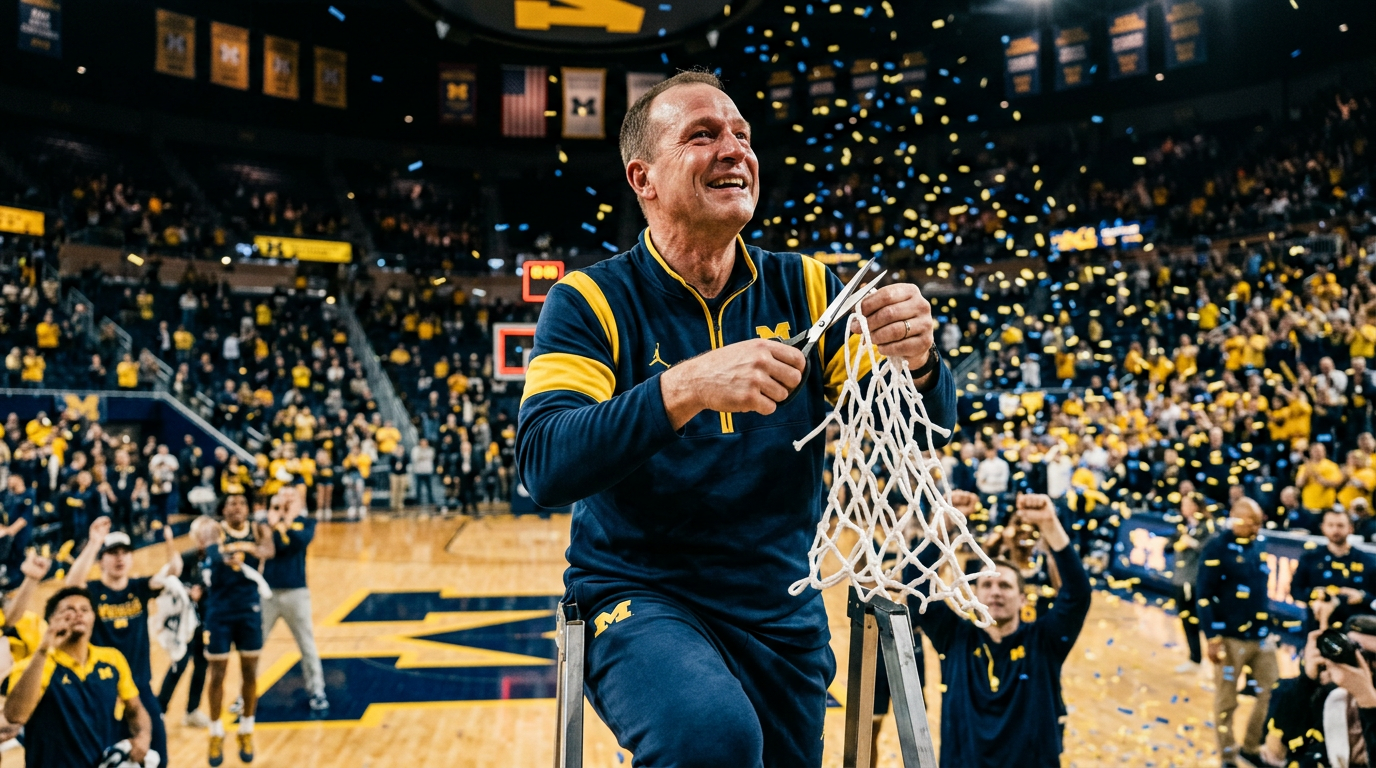
Twenty-nine years later, May stood at center court in Lucas Oil Stadium — the arena built on the footprint of the demolished RCA Dome — and lifted the national championship trophy over his head. Michigan had just beaten UConn 69-63 to win its first title since 1989, tying the Big Ten single-season wins record at 37-3. His starting five included zero players he'd recruited out of high school. His roster was assembled almost entirely from the transfer portal. His suit was covered in confetti that belonged to a program he'd coached for exactly twenty-three months.
Indianapolis gave Dusty May a coaching career the first time. It gave him a championship the second.
From Equipment Room to Trophy Stage
What Knight Left Behind
Before May was a head coach, before FAU and the Final Four run that stunned the country in 2023, he was a kid from Bloomfield, Indiana — population barely over two thousand. He attended Eastern Greene High School and walked on at Indiana not as a player but as a team manager, the lowest rung on the basketball hierarchy, fetching water bottles and rebounding during shooting drills for a coach who threw chairs.
Bob Knight didn't coddle his managers any more than he coddled his players. May has spoken about this directly. "There's a fear element," he told Fieldhouse Files. "You're always anticipating what's next, problem solving where you're anticipating what could be the next problem. Those are the things I learned most from Coach Knight — the preparation, the anticipation." Knight taught May to see breakdowns before they materialized, to build systems that survived pressure, and to demand more from everyone in the building than they believed they could give. May absorbed every lesson and discarded the rage that came with it.
His first Final Four game came in 2002, courtesy of then-Indiana coach Mike Davis, who created a staff position to bring May back after the Hoosiers lost to UNC-Wilmington. After that, May spent years climbing the assistant coaching ladder through mid-major programs that didn't generate headlines or television contracts. The path from Knight's equipment room to a head coaching job took two decades. It was supposed to take longer.
The FAU Blueprint
Florida Atlantic hired May as head coach in 2018. FAU was an afterthought in the college basketball ecosystem, a Conference USA program more associated with spring break than March Madness. May went 35-30 in his first two seasons. Nobody outside Boca Raton noticed.
The 2022-23 FAU Owls changed that. They went 35-4 and reached the Final Four as a nine-seed, beating Memphis and Tennessee along the way in one of the most improbable tournament runs in recent memory. These weren't blue-chip recruits on a joyride. They were transfers, overlooked prospects, and players who other programs had evaluated and passed on. May saw something in them that previous coaches missed, built a system around their strengths instead of forcing them into someone else's template, and rode it all the way to the national semifinals.
That run accomplished two things simultaneously. It established May as one of the sharpest roster-builders in the sport. And it made him impossible for Michigan to ignore after the Wolverines' catastrophic 2023-24 season — eight wins, twenty-four losses, nineteen defeats in their final twenty-one games. When Michigan called, May didn't hesitate. He left paradise for a program that looked like a demolition site.
The Roster Nobody Thought Would Work
The wreckage May inherited at Michigan was comprehensive. The roster was depleted. The culture was fractured. The fan base, spoiled by decades of relevance, was furious and checked out in equal measure. May had exactly one asset worth leveraging: Michigan's brand still carried weight in the transfer portal, even when the win-loss record didn't.
His solution was radical in its simplicity. He would build the entire starting lineup from the portal, stacking it with proven college producers who shared two qualities — talent and something to prove.
Elliot Cadeau came from North Carolina, where he'd been a five-star point guard recruited by Hubert Davis before the program imploded. At UNC, Cadeau showed flashes of brilliance but never found the consistency his recruiting profile promised. At Michigan, May gave him the keys and told him to drive. Cadeau responded by leading the team in assists and becoming the engine of an offense that would set NCAA Tournament records nobody saw coming.
Yaxel Lendeborg arrived from UAB, a program roughly seven hundred spots below Michigan in the public imagination. Lendeborg had been one of the best-kept secrets in college basketball — a versatile forward who could score from every level but played in an arena where national scouts rarely ventured. At Michigan, he became the Big Ten Player of the Year and a legitimate All-American. The gap between his talent and his previous platform was the transfer portal's entire thesis in one player.
Morez Johnson Jr. transferred from Illinois, where he'd been a productive but overshadowed piece on Brad Underwood's Final Four team. Aday Mara, a 7-foot-3 center, came from UCLA, where he'd been buried behind a crowded frontcourt. Nimari Burnett arrived via the longest route of all — Texas Tech to Alabama to Michigan — a guard who'd survived enough coaching changes and program upheavals to fill a memoir. Only two of May's eight rotation players, freshman Trey McKenney and fifth-year senior Will Tschetter, had been recruited to Michigan out of high school. Everyone else carried the scars of programs that didn't work out, and May didn't ask them to forget those experiences. He asked them to weaponize them.
Michigan's All-Transfer Starting Five
Nobody cared about stats the whole season. Nobody cared about nothing but winning.
Ninety Points, Five Straight Times
Michigan's regular season was dominant — Big Ten regular season champions, Big Ten Coach of the Year for May — but the NCAA Tournament is where the roster's construction revealed its true purpose. These were players who had been through everything college basketball can throw at a person: coaching changes, system transitions, culture shocks, campus relocations. Nothing about six games in three weeks was going to rattle them, because the tournament wasn't the hardest thing any of them had endured.
The Wolverines scored 90 or more points in each of their first five tournament games — an NCAA record that may stand for years. They weren't just advancing through the bracket. They were overwhelming opponents with a combination of size, speed, defensive versatility, and offensive firepower that no scouting report could fully neutralize, partly because the five players sharing the floor had never shared a floor before this season.
The blowouts mounted. Lendeborg poured in 23 points as Michigan rolled past Alabama into the Elite Eight. Tennessee — Rick Barnes' team, riding three straight Elite Eight appearances — was dismantled 95-62 in a game that stopped being competitive before halftime. The Final Four semifinal against Arizona was supposed to be the game of the year, a collision of number-one seeds. Michigan won 91-73. Tommy Lloyd's team never had a chance.
Championship Night at Lucas Oil
The championship game against UConn was different. Dan Hurley's team had clawed back from nineteen points down to beat Duke in the Elite Eight — the greatest comeback in tournament history — and they brought that survival instinct to Indianapolis. Michigan couldn't find its three-point shot, going 2-for-15 from beyond the arc, and for the first time in the tournament, the Wolverines looked mortal.
What saved them was precisely what May had built the roster to do: adapt, compete, and grind out a win that the box score wouldn't celebrate. Cadeau scored 19 points and earned the Final Four's Most Outstanding Player award. Johnson posted a 12-point, 10-rebound double-double that anchored the paint. Lendeborg, playing through ankle and knee injuries that had bothered him for weeks, scored 13 points in 36 minutes on 4-for-13 shooting and refused to come out of the game even when his body begged him to sit.
The decisive sequence came with Michigan clinging to a shrinking lead. Burnett forced a steal that led to an alley-oop dunk by Mara — pure transition basketball, the kind of play that requires trust between players who'd only shared a locker room for nine months. Lendeborg then scored six consecutive points to push the lead to 65-56 with four minutes left. UConn rallied with a banked three-pointer and late free throws, but McKenney sealed it from the line in the final seconds. Michigan 69, UConn 63. The Wolverines shot 38.2 percent from the floor, made 25 of 28 free throws, held UConn to 30.9 percent shooting, and won a national championship on defense, free throws, and the kind of composure that comes from players who've already survived worse.
The Accusations That Followed the Confetti
The champagne was still cold when the backlash arrived. Throughout Michigan's dominant season — 25-1 by mid-February — rival fan bases and anonymous social media accounts had been circulating tampering allegations against May's program. The most persistent claim involved Purdue guard Braden Smith, with unfounded accusations that Michigan had illegally recruited him during the Big Ten Tournament.
Michigan assistant coach Mike Boynton addressed it directly during the postgame celebration. "It's nonsense," he told Sports Illustrated. "People are fairly envious of Dusty, and it's because we're doing this." On the specific Smith allegation, Boynton was blunt: "You cannot get juniors into school at Michigan," referencing the university's academic transfer requirements that would make such recruitment structurally impossible.
Boynton didn't stop there. "People just trying to find a reason to bring down what's a pretty remarkable dude, because there's really nothing else to get him on. He's pretty open, he talks to everybody, he works his ass off." Then the line that cut deepest: "When the hate don't work, they start telling lies." No investigation has been opened. No evidence has surfaced. Michigan invested substantial NIL resources — as did every other program competing at this level. The difference was execution, not ethics, and that distinction infuriated the programs whose portal classes didn't produce a trophy.
The Machine Never Stops
May got approximately one hour of sleep on championship night. The transfer portal had opened at midnight, twenty minutes before his postgame press conference. By the time he woke up Tuesday morning, over a thousand players had entered the system. His own roster was already shifting — Lendeborg and Burnett had exhausted their eligibility, Mara and Johnson were likely NBA-bound — and the cycle of construction that produced a championship was already beginning again.
Three days after cutting down the nets, Michigan received its first portal commitment of the new cycle: JP Estrella, a Tennessee forward who'd averaged 9.7 points and shot 40 percent from three. The same Tennessee team Michigan had beaten 95-62 in the Elite Eight. The player who lost to Michigan decided the best path forward was joining them. That single commitment tells you everything about where the sport is heading.
May returned to Ann Arbor and addressed the crowd at Crisler Center with the trophy resting beside him. "This trophy is yours," he told the fans. "You brought it all year, every home game. You guys were there every step of the way." He thanked last year's team, the one that came up short. "Those guys laid the foundation, established an identity for us, and also helped attract these guys to come in and chase this dream together."
The championship validated May's model — proven college players, assembled quickly, coached to trust each other fast — and now every program with resources will attempt to replicate it. The portal will grow larger. The turnover will accelerate. And every April, a new class of coaches will study what May built and try to reverse-engineer it with their own collection of somebody else's players.
Dusty May was a manager who couldn't afford a ticket in 1997. He's a champion who can't afford to stop working in 2026. The building changed. The city didn't. And the kid from Bloomfield, Indiana — population two thousand and change — finally has a banner of his own.