
The Two-Point Game
Brad Underwood had already seen the 36-point explosion. That was impressive enough — any high school kid can get hot for a night and pour in buckets while the gym buzzes and the AAU coaches tap notes into their phones. What stopped Illinois's head coach cold was the game that came next, when the same kid scored two points.
Two. On a night when every shot-happy teenager in America would have forced the issue, when the natural instinct is to prove the first performance wasn't a fluke, Keaton Wagler ran the offense. He passed out of double teams. He found open shooters. He played like a point guard wearing a shooting guard's jersey, and he didn't seem remotely bothered that his name never showed up in the scoring column.
Underwood walked out of the gym and called his son Tyler, an assistant on his staff. "We just got an incredible talent," he said. He hadn't offered Wagler yet. He hadn't even watched him play in person. But he'd seen enough film of those two consecutive games — the 36 and the two — to understand something the rest of college basketball's recruiting apparatus had missed entirely.
The recruiting machine missed its best player
The 261st-Best Player in America
Fifteen months before he'd score 46 points at Mackey Arena and shatter Illinois's freshman scoring record, before NBA scouts would start whispering the names Shai Gilgeous-Alexander and Tyrese Haliburton in the same breath as his, Keaton Wagler was a three-star recruit from Shawnee, Kansas, ranked 261st in the 247Sports Composite. The University of Missouri-Kansas City was his only Division I offer heading into the summer before his senior year.
The family wasn't alarmed. Basketball disappointment wasn't something the Waglers experienced often, but patience ran in their bloodline the way jumpers did. Keaton's parents, Logan and Jennifer, met playing college basketball at Hutchinson Community College — the storied juco program in central Kansas that has been a basketball factory for generations. His great-grandfather played at Hutch and later at TCU. His grandfather suited up there in the mid-1960s. An uncle helped Hutch win the 1994 juco national championship. His older sister Brooklyn won a juco national title at Kansas City Kansas Community College. His brother Landon played at Hutch too, before moving on to MidAmerica Nazarene.
Growing up, the Wagler kids turned everything into a competition. Brooklyn remembered the family games in the driveway: "We would all get out there. Sometimes it was boys versus girls. We'd play knockout, we'd play PIG." Logan, who stands 6-foot-5 and worked his way from high school coaching to director of parks and recreation in Lenexa, Kansas, noticed something different about his youngest. "He would really watch," Logan said. "He'd ask questions and just had a good grasp for the game." By elementary school, Keaton was directing adults on the court at pickup games at the Lenexa Rec Center where his father worked. David Birch, an NAIA All-American who had played with the Harlem Globetrotters, was a regular at those runs. He remembered an 11-year-old Keaton scoring on him and laughing about it afterward. "Why are you letting this 11-year-old score?" Birch asked the other adults. Nobody had a good answer.
Birch would later become Wagler's high school coach at Shawnee Mission Northwest. He put the undersized freshman — just 5-foot-8 — on varsity alongside older brother Landon. Growth spurts came. Four inches before sophomore year. By the time Wagler was leading the Cougars to back-to-back Kansas 6A state championships in 2024 and 2025, the first titles in program history, he was 6-foot-6 and the best player in the state. But the recruiting world still hadn't caught on. "Most of the feedback was, they pegged him as a mid-major kid," Birch told ESPN. "They didn't think he was quite strong enough."
Part of the problem was visibility. Wagler played for VWBA Elite, an independent Kansas City-based AAU program run by Victor Williams. No shoe sponsorship. No Nike EYBL circuit. No Peach Jam. In a recruiting ecosystem where exposure is currency, Wagler was playing with pocket change. He had chances to leave for bigger programs but stayed loyal. Williams appreciated it, but he also understood the cost: college coaches were in the gym, watching Wagler play, and walking away without offering.
"A who's who of college basketball has called me," Williams said later, after everything changed. "And said, 'I should have listened to you.'"
If you get wrapped up in numbers, then you probably could miss him. If you get wrapped up in the context and content of how he plays, you probably liked him a lot.
The Phone Call From Kansas City
Tyler Underwood had Kansas City connections. He kept hearing the same name from people he trusted — coaches, trainers, friends in the basketball community who had watched Wagler dismantle opponents for Shawnee Mission Northwest's undefeated team. He watched film and brought it to his father. Illinois evaluates recruits on four pillars: positional size, basketball IQ, character, and correctable skill deficiencies. Tyler's assessment of Wagler was rare: "We thought he was 4-of-4, which is very rare."
Colorado State assistant Ali Farokhmanesh, who had also been tracking Wagler, understood why so many coaches missed him. The kid didn't scream future pro at first glance. "If you just went once, I don't know if you would have just walked away and been like, this is a high-major lottery pick guy," Farokhmanesh told Sports Illustrated. Wagler's brilliance required patience. You had to watch him three or four times before the picture came into focus — the way he manipulated angles, read help defense two passes ahead, made the right play over the spectacular one.
Murray State coach Steve Prohm initially had Wagler buried on a list of 24 guards. Then he saw him play. "I'm texting my staff the whole time," Prohm recalled, "'Guys, why are we not all over this kid?'" He recognized something he'd seen before — at Iowa State, where Prohm had coached a skinny, cerebral guard named Tyrese Haliburton who became the fourth overall pick in the 2020 NBA Draft.
In August 2024, everything accelerated. Minnesota and Illinois offered on the same day — the only two high-major offers Wagler would receive. He committed to Illinois a month later. His reasoning was disarmingly simple: "If this was my only high-major offer, I would be happy, because this is where I'm happy."
Brad Underwood, who had built his career partly on evaluating talent that others overlooked during stints at Stephen F. Austin and at JUCO programs before that, put it bluntly: "If you get wrapped up in numbers, then you probably could miss him. If you get wrapped up in the context and content of how he plays, you probably liked him a lot."
Half a Pancake
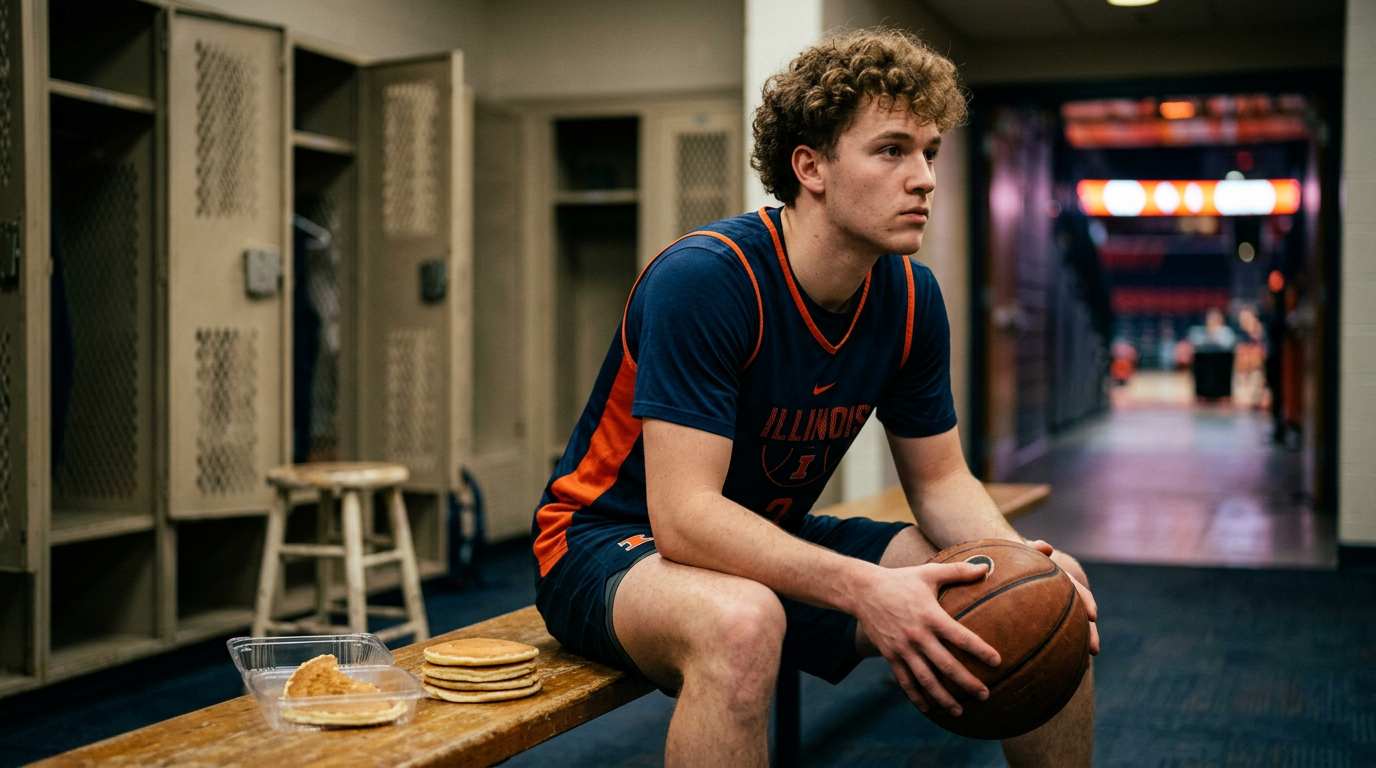
Wagler arrived in Champaign at 168 pounds. His first day in the weight room ended with him vomiting. Illinois strength coach Adam Fletcher didn't panic. He'd seen thin freshmen before, and he knew the protocol: incremental gains, obsessive nutrition, patience. "You go from half a pancake to a full pancake," Fletcher explained to ESPN. "That's the exact same thing as going from bench-pressing 95 pounds to 115 pounds."
The pancake benchmark became a running joke on the team and then something more — a symbol of Wagler's methodical approach to everything. By February 13, he ate his first full pancake, a milestone the staff tracked with the same precision they applied to his three-point percentages. He'd gained 17 pounds, reaching 185 while adding nearly three inches to his vertical leap. The body was catching up to the mind.
On the court, the adjustment was faster. Wagler scored in double figures in each of his first four college games, starting with 18 points, six rebounds, and four assists against Jackson State in his debut. But after struggling against tougher competition — he played just 14 minutes in a loss to UConn at Madison Square Garden in early December — Underwood made the decision that would define both their seasons. He moved Wagler to point guard and handed him the keys.
"I wasn't using him right," Underwood admitted. "We had to get him on the ball."
The results were immediate and staggering. Wagler recorded a 10-assist game against Nebraska, then matched it two games later against Southern. He scored in double figures in 21 consecutive games after the switch, posting five-plus assists 11 times with two or fewer turnovers in 15 of them. Senior guard Kylan Boswell pulled Underwood aside and offered a succinct evaluation: "Coach, he's really cold. There's nothing he doesn't have."
Keaton Wagler: Recruit vs. Reality
Forty-Six in West Lafayette
January 24, 2026. Mackey Arena, West Lafayette, Indiana. Fourth-ranked Purdue was 16-2 and riding the deafening home-court advantage that makes their arena one of the most hostile environments in college basketball. Illinois was solid but unspectacular, a team that most bracketologists had penciled in as a six or seven seed if the season ended that day.
Wagler scored 46 points. He went 13-for-17 from the field and 9-for-11 from three. He opened the game with a layup, then buried four consecutive three-pointers, one from 28 feet. He scored 24 in the first half while the Mackey crowd went from hostile to quiet to something approaching awe. It was the most points ever scored by a visiting player at Mackey Arena, the most points by a Big Ten player against an AP top-five opponent, and the most by a Big Ten freshman in 30 years.
Tyler Underwood tried to articulate what the staff had witnessed: "When people talk about magical performances, that's what they're referring to."
The 46-point game didn't just set records. It altered the trajectory of Illinois's season, transforming a good team into a team that believed it could beat anyone. It moved Wagler from regional curiosity to national phenomenon, launching him to No. 6 on ESPN's NBA draft big board. Since 2008, only Dennis Smith Jr. (2017) and Bub Carrington (2024) have been U.S.-born players recruited outside the top 100 who became lottery picks. Wagler, ranked 261st, appears poised to join them.
Underwood reached for a historical comparison. "He's one of the greatest stories in a long, long time," the coach said. "Tracy McGrady, 30 years ago, kind of showed up at a camp and blew up. That's what this is about."
This is what kids dream of. I know I dreamed of this when I was growing up, playing in the Final Four, competing for a national championship.
The Unbothered Mentality
There is a quality to Wagler that separates him from every other player in the Final Four, and possibly from every freshman in America. Victor Williams calls it "the unbothered mentality." Underwood describes him as "the most stoic, emotionless" player he's coached — and then adds the kicker: "and yet he's just that silent killer."
Before games, teammates check on him. Is he locked in? Is he focused? They find him sitting at his locker, smiling, making jokes. "I don't like being too locked in," Wagler has explained, offering a window into a competitive psychology that would be remarkable in a 10-year NBA veteran, let alone a 19-year-old freshman. The preseason scrimmage against defending national champion Florida was the first real test of whether that composure would hold against elite competition. Underwood watched Wagler absorb contact from bigger, stronger players and never flinch. "The most physical scrimmage, just brutal," the coach recalled. "He was as good a player as there was on the court."
Williams, who has coached Wagler since he was a teenager, believes the composure isn't a mask. It's who he is. "With Keaton's instincts and feel for the game, that's generational also," Williams told Sports Illustrated. "That doesn't come around often."
The feel shows in the box score and in the plays that never show up there. Against Northwestern, facing constant blitzes, Wagler attempted just eight shots. He found teammates, ran the offense, and won the game by making others better. It was the two-point game from high school all over again — the willingness to disappear from the scoring column when the defense demanded it, the understanding that basketball intelligence matters more than basketball ego.
Saturday in Indianapolis
Illinois hasn't been to the Final Four since 2005, when a team led by Deron Williams and Luther Head pushed North Carolina to the wire in the national championship game. The drought lasted 21 years. It ends Saturday at Lucas Oil Stadium in Indianapolis because a three-star kid from Kansas that almost nobody recruited chose to stay loyal to his AAU coach, chose Illinois over prestige, and chose to eat half a pancake at a time until his body caught up with his brain.
Wagler's tournament has been as dominant as his January: 17.5 points, 6.5 rebounds, and 3.8 assists per game across four NCAA Tournament wins, all by double digits. He scored 25 in the Elite Eight victory over Iowa, earning South Region Most Outstanding Player honors. His teammate Andrej Stojakovic captured the team's mindset in the aftermath: "I don't want anybody to think that this is it. We didn't get to the Final Four just to get there. We're coming to win two more games."
What the Numbers Can't Measure
In an era when college basketball is defined by NIL billions, portal chaos, and the relentless churn of mercenary roster-building, Keaton Wagler's story reads like a dispatch from another century. A kid stays with his non-shoe-sponsored AAU team. A kid picks the school where he's happy over the school with the bigger brand. A kid works his way from half a pancake to 185 pounds and from 261st in the country to the best player in the Final Four.
Brad Underwood framed it perfectly: "Keaton's one of the fabulous stories about what the college experience should be about. The expectation coming in wasn't to be a pro or to get rich or to be famous. It was to be a winner and participate on a basketball team."
Kentucky spent $22 million on a roster that exited in the second round. BYU invested $13 million around the top NIL earner in the sport and went home in the first weekend. Meanwhile, the most compelling player left in the tournament arrived in Champaign as the 261st-ranked recruit in his class, vomited on his first day of lifting, and couldn't finish a single pancake.
The 2026 Final Four features Arizona and its 25-year drought ending, Michigan two years removed from 8-24, and UConn chasing a third title in four seasons. All remarkable stories. But none of them carries the weight of what Wagler represents — proof that the recruiting-industrial complex, with its star ratings and shoe circuits and seven-figure NIL packages, still can't quantify the thing that matters most.
"It just shows that there's not one path," Wagler said. "There's not a set way for you to go."
Somewhere in Kansas City, Victor Williams is still answering calls from the coaches who didn't listen.