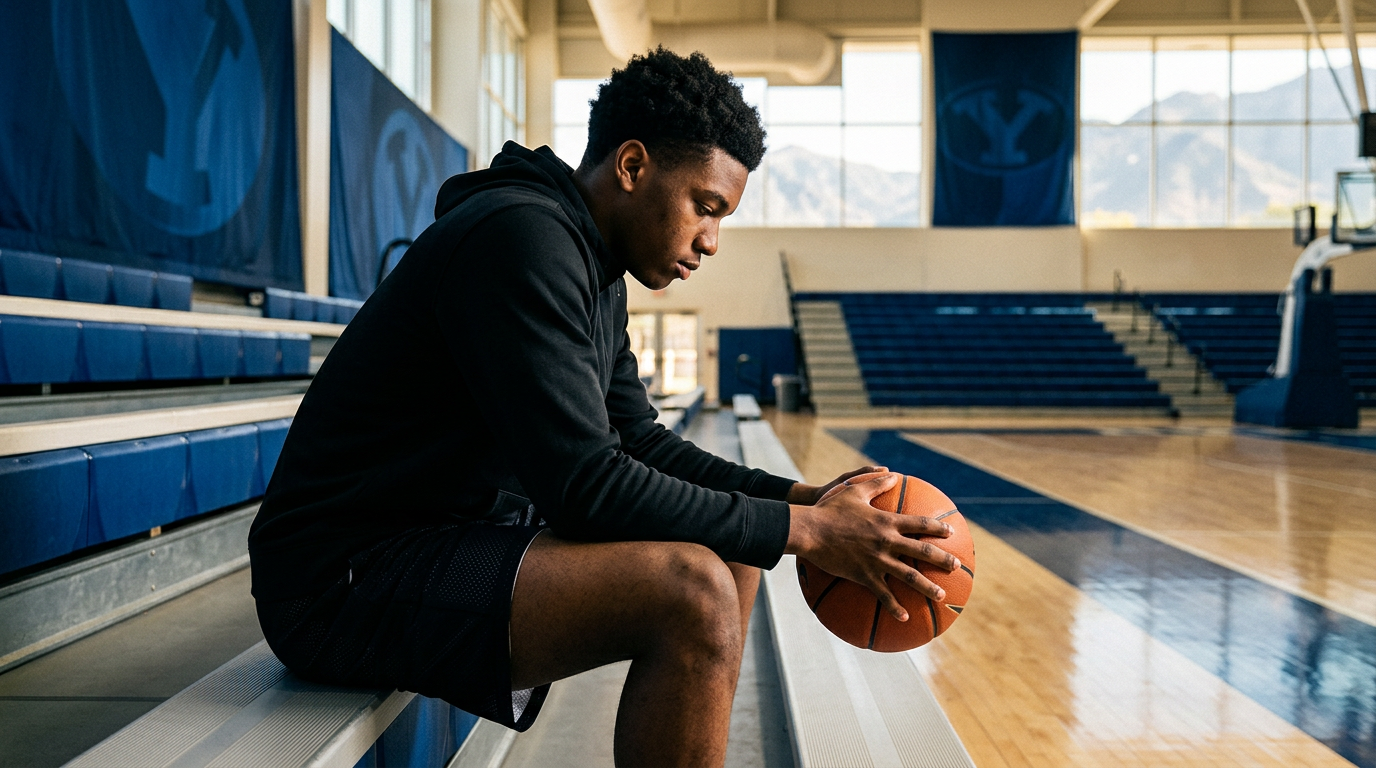
Anicet "Ace" Dybantsa is a Congolese immigrant who worked as a Boston University police officer. He raised his son AJ in Brockton, Massachusetts, a working-class city twenty miles south of Boston where the high school basketball games draw a couple hundred people on a good night and the idea of a $7 million NIL deal belongs to a different universe entirely. Ace set one rule early in the recruiting process: no school would be taken seriously unless it could guarantee approximately $5 million. Multiple programs met that number. Kansas met it. Alabama met it. North Carolina met it. The money, Ace understood, was the baseline — the cost of entry into a conversation that would determine the next phase of his son's life. What mattered was what came after the money.
What came after the money, for AJ Dybantsa, was a coach named Kevin Young.
Young had spent nearly a decade in the NBA, most recently as the highest-paid assistant coach in league history with the Phoenix Suns, where he worked daily with Kevin Durant and Devin Booker — the latter being Dybantsa's favorite player since childhood. When Dybantsa sat down to explain his decision on ESPN's First Take, he did not talk about campus visits or conference prestige or the tradition of any particular program. He talked about proximity to the NBA. "He coached my favorite player of all time, Kevin Durant," Dybantsa said of Young. "At BYU, the whole staff from the head coach on down came from the NBA. You cannot get any closer to where I want to be."
When Stephen A. Smith asked why he didn't choose North Carolina, Dybantsa fired back with the confidence of a teenager who has already decided that the adults in the room are asking the wrong questions: "Who said I can't play Duke at BYU?"
Before Kevin Young arrived, BYU had never signed a single five-star recruit. He has now signed three in three years.
The Accident That Made It Possible
The story of how AJ Dybantsa ended up in Provo begins not with a recruiting visit but with a failing prep school in Salt Lake City and a coaching controversy that nobody involved seems eager to discuss in detail.
Before his senior year, Dybantsa enrolled at Utah Prep, a startup prep school that offered him approximately $600,000 in NIL money and his father an ownership stake in the program. It was supposed to be a launchpad — a place where the No. 1 recruit in the country could sharpen his game against elite competition while building his brand in a market hungry for basketball content. Instead, the season disintegrated almost immediately. Head coach Justin Yamzon was fired mid-season under circumstances that remain murky, though the timing suggested pressure from the Dybantsa family played a role. Yamzon later reflected with the kind of measured bitterness that comes from being a footnote in someone else's story: "Ultimately AJ wasn't on our flight, I got fired and then he showed up the next day. Read into that what you will."
The dysfunction at Utah Prep had an unintended consequence that would reshape the entire recruiting landscape: it put Dybantsa in Utah, within driving distance of Provo, where Kevin Young was building something that didn't have a precedent in college basketball. BYU assistant Brandon Dunson was candid about the stroke of fortune: "I don't know that we ever would have been able to get in front of him if he weren't at Utah Prep. So it was definitely a stroke of good luck for us."
The Honor Code Question
BYU's CES Honor Code bans premarital sex, alcohol, coffee, tea, and the use of profanity. For a program trying to recruit teenagers from diverse cultural backgrounds, the code is either an insurmountable obstacle or a non-issue, depending on who you ask and how honest they are being.
Dybantsa is Catholic, not Mormon. He grew up attending St. Sebastian's, an all-boys Catholic school in Needham, Massachusetts. His faith has nothing to do with the Church of Jesus Christ of Latter-day Saints. But BYU requires all students to be religiously active, and Dybantsa complied — taking Mission Prep and Book of Mormon courses (earning an A in both) and adhering to the behavioral standards that the code requires. Reports surfaced that he was suspended for the first half of a game against Holy Cross for using profanity during practice, though BYU never officially confirmed the reason. His father dismissed the concern with the weary pragmatism of a man who has heard every possible criticism of his son's college choice: "The kid don't go nowhere. He's not the type of kid who wants to go hang out at the bar. He's all about books and basketball."
The honor code debate reveals more about the assumptions of the people asking the questions than about Dybantsa himself. The implicit suggestion — that a young Black man from Massachusetts would struggle with the cultural restrictions of a Mormon university — carries a condescension that Dybantsa and his family rejected by simply showing up, doing the work, and earning the grades.
The Season: Brilliance Without a Safety Net
What Dybantsa did on the court at BYU was extraordinary by any standard. He averaged 25.5 points, 6.8 rebounds, and 3.7 assists per game over 35 games, shooting 51.0% from the field, 33.1% from three, and 77.4% from the free-throw line. He was named Big 12 Freshman of the Year, First Team All-Big 12, and First Team AP All-American — only the third player in BYU history to earn that distinction, the first since Jimmer Fredette in 2011. He set BYU's freshman scoring record with 43 points against Utah, a performance that had the arena in Provo vibrating at a frequency the building had never experienced.
The problem was everything around him. When teammate Richie Saunders suffered a season-ending injury, BYU's bench depth evaporated. Dybantsa was not just the best player on the team — he was the only player who could reliably create offense against high-major competition. The limitation was exposed brutally in the NCAA Tournament, where 11-seed Texas schemed entirely around stopping Dybantsa and dared the rest of the roster to beat them. Dybantsa scored 35 points and played every minute. BYU lost 79-71. He had five turnovers against a defense that put two bodies on him every possession and got zero meaningful scoring from anyone else.
The first-round exit prompted the inevitable question: was the $7 million worth it? The answer depends on what you think BYU was buying. If it was buying a championship, the investment failed. If it was buying credibility — proof that BYU could land the No. 1 recruit in the country, compete in the Big 12, and position itself as a legitimate destination for elite talent — then the $7 million was the most cost-effective branding campaign in the history of college athletics. Bruce Branch III, the No. 1 player in the 2027 class, reclassified to 2026 and committed to BYU shortly after watching Dybantsa in warmups. Three consecutive five-star classes. Before Kevin Young arrived, BYU had never signed a single one.
The Money Behind the Money
The financial infrastructure that made Dybantsa's deal possible is worth understanding, because it explains how a program in Provo, Utah, outbid schools with generations of basketball tradition and donor networks dating back decades.
BYU booster Paul Liljenquist, the CEO of Focus Services, made the program's ambitions explicit: "You're not going to outbid us." A meeting of BYU basketball boosters reportedly included individuals with a combined net worth exceeding $10 billion, the product of Utah's "Silicon Slopes" tech boom — the same economic engine that has turned Salt Lake City into one of the fastest-growing metropolitan areas in the country. The money flowing into BYU's NIL collective is not old-money philanthropy. It is new-money ambition from tech entrepreneurs who see basketball as the next investment thesis.
Dybantsa's total compensation package reportedly approached $7 million when national sponsorships were included — Nike, Red Bull, Fanatics (an eight-figure trading card and memorabilia deal), and other brand partnerships that exist independently of BYU's collective. The collective's portion was estimated at $4-5 million. For a single season of college basketball. For a player who will almost certainly be the No. 1 pick in the 2026 NBA Draft.
His mother Chelsea wants him to graduate. Dybantsa himself has said "I never said I was a one-and-done." Experts say a return would be "the biggest shocker in college basketball/NBA Draft history." But the Dybantsa family has made a habit of confounding expectations, and the only person who knows what AJ will do next is AJ — and possibly his mother, who is described by everyone close to the family as "behind the wheel" when it comes to decisions that matter.
What Dybantsa Proved
The significance of AJ Dybantsa's year at BYU extends beyond the points scored and the games won and lost. What he proved — what his family proved, what Kevin Young proved — is that the concept of a "blue blood" in college basketball is no longer defined by history. It is defined by coaching staff, financial infrastructure, and development pitch.
Kansas has six national championships and a coaching lineage that runs through Phog Allen and Dean Smith to Bill Self. Duke has five titles and the cultural weight of Coach K. North Carolina has the Dean Smith Center and the most decorated coaching tree in the sport. None of them could offer what Kevin Young offered: an NBA coaching staff in a college uniform, a booster base willing to meet any financial demand, and a development philosophy built on the premise that college basketball is not the destination — it is the layover.
Dybantsa chose the layover. He made it the most expensive, most scrutinized, and most successful single-season experiment in recruiting history. Whether BYU can sustain what he started — with Branch arriving next fall and the Silicon Slopes money continuing to flow — will determine whether the Dybantsa season was an anomaly or a blueprint. Either way, the Catholic kid from Brockton proved that you don't need to go to a blue blood to be treated like a franchise player. You just need a coach who knows what the NBA looks like from the inside and a booster base that refuses to be outbid.